
Accountability, Mirrors and the Space Between
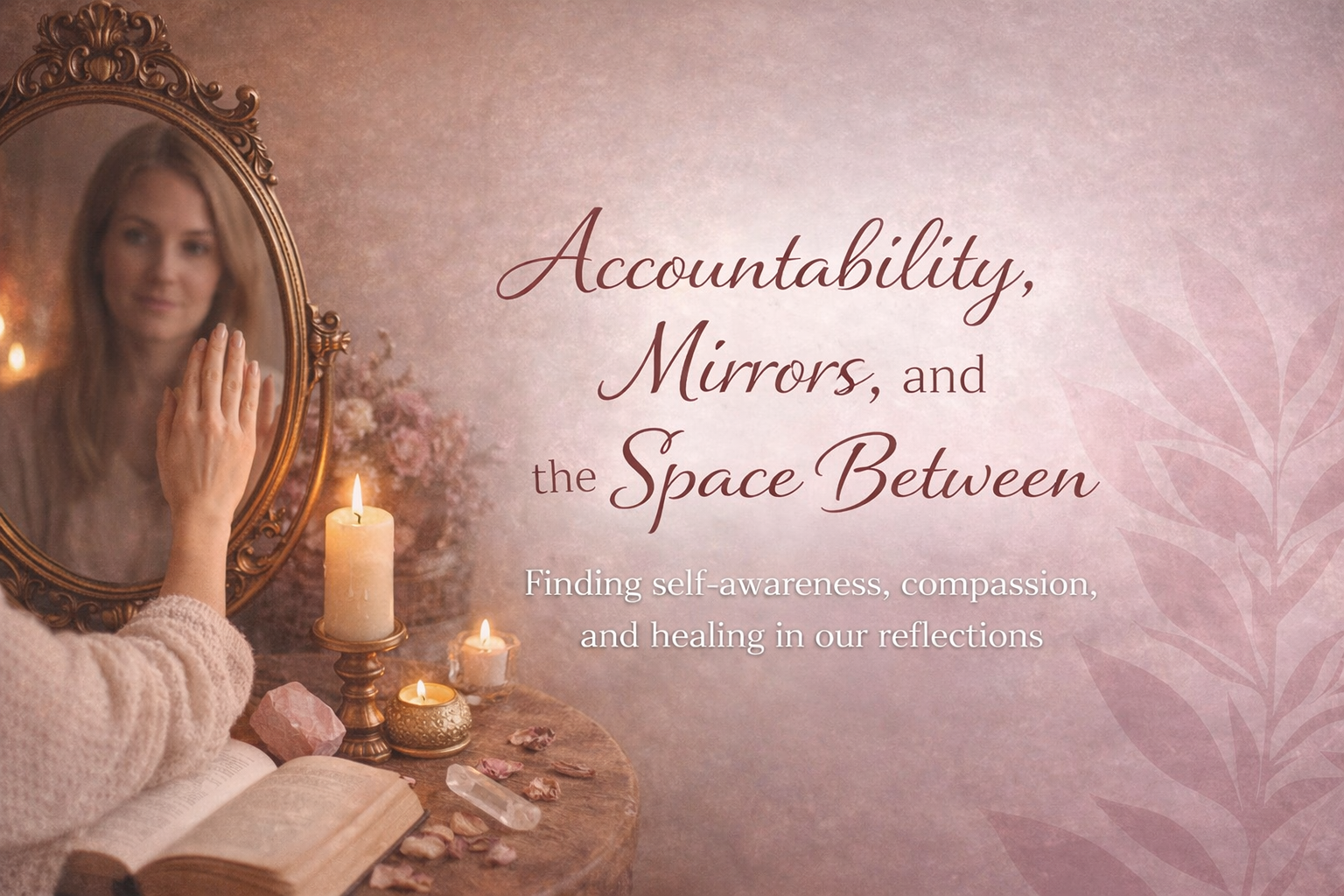
Accountability, Mirrors, and the Space Between
One of the deepest shifts in my healing journey came when I began to understand the difference between blame and accountability.
For a long time, I believed that if I had been hurt, then the story ended there. Someone did something. Someone said something. Someone treated me in a way that left a mark. And while those experiences were real, staying inside that story kept me tied to it.
Accountability changed everything.
Taking accountability does not mean taking responsibility for someone else’s behaviour. It does not mean excusing harm or pretending something was acceptable when it wasn’t. What it does mean is recognising the part we carry within the experience.
Sometimes that part is simply how we reacted.
Sometimes it is a pattern we repeated.
Sometimes it is a wound that was already there, waiting to be touched.
Accountability also moves in both directions. It asks us not only to reflect on what others did to us, but also on how our own actions may have affected someone else — even when that was never our intention.
Our intention and another person’s experience are not always the same thing.
When we can acknowledge that our words, reactions, or choices may have impacted someone else, something powerful happens. The other person often feels seen and heard. Their experience becomes valid too. Even when we remember the same situation differently, taking accountability for our own part allows space for another person's feelings to exist without needing to defend ourselves or argue the story.
Sometimes the most healing thing we can offer another person is simply the validation of their experience, without needing to explain our side of the story.
When someone feels that their feelings have been acknowledged, the energy around the situation can soften. It creates space where healing, understanding, or even simple peace can begin.
And being seen and heard is something every human being longs for.
When we allow another person’s experience to be valid, something else happens too. Validation is not a one-way act. When someone feels safe enough to share how something resonated with them, it also reflects back to us that our own experience matters.
In that moment, both people are seen — the one who shared and the one who recognised themselves in the story.
Sometimes healing happens in that shared space, where one person’s honesty gives another permission to recognise their own.
As healing deepens, something else begins to shift. We start to realise that while it can be beautiful to have our experience acknowledged by others, our healing no longer depends on it. There comes a point where we learn to witness our own pain, validate our own feelings, and honour our own truth without needing someone else to confirm it for us.
That is a different kind of freedom.
It means we can receive validation when it comes, but we are no longer abandoned without it.
But there is another side to this that is even more transformative.
When we step beyond the story of what happened — beyond what they said, what they did, how they treated us — and look at what the situation is mirroring back to us, we move into a completely different kind of power.
The mirror asks deeper questions.
Why did this land so deeply in me?
What belief inside me is being touched here?
What part of myself still needs compassion or attention?
It can also ask something even more subtle.
What emotion is this nudging within me, and why?
Instead of pushing that feeling away or reacting immediately, there is power in simply sitting with it. Observing it. Allowing it to be present without judgement.
Often beneath those emotions is a younger part of us that once learned how to protect itself the only way it knew how. When we slow down enough to notice that, we can begin to validate that inner child rather than silence them.
Sitting with an emotion, witnessing it, and offering that part of ourselves understanding and compassion is deep work too.
This is not about self-blame. It is about self-awareness.
Because when we are willing to look inward instead of only outward, the experience stops being something that was done to us and becomes something we can learn from.
That is where empowerment lives.
It is in the willingness to feel what is rising within us, to listen to what our emotions are trying to show us, and to meet ourselves with honesty rather than defence.
In that space, something else becomes possible too: forgiveness.
Not the kind of forgiveness that dismisses what happened or pretends it didn’t hurt, but the kind that releases the weight we have been carrying.
Sometimes forgiveness is for the other person, recognising that they too were acting from their own wounds, limitations, or lack of awareness. And sometimes forgiveness is for ourselves — for the ways we stayed too long, reacted in ways we regret, or simply didn’t know then what we understand now.
Self-forgiveness can be one of the most powerful parts of healing. It allows us to release the harsh judgement we place on our past selves and meet that version of us with compassion instead.
Because we were always doing the best we could with the awareness we had at the time.
Breaking generational cycles is not just about changing what we do outwardly. It is about changing how we meet ourselves inwardly.
When we take accountability where it is ours, allow others to feel seen in their experience, and listen to what the mirror is revealing within us, we step out of the old loops of blame and defence.
We step into responsibility, awareness, compassion, and choice.
The truth is, none of us get through life without hurting someone or being hurt ourselves. But healing begins the moment we stop fighting the story and start listening to what it is revealing within us.
Every interaction holds a mirror.
Sometimes it reflects our wounds.
Sometimes it reveals our patterns.
And sometimes it shows us the exact place where healing is asking to begin.
When we allow others to feel seen in their experience, sit honestly with the emotions that rise within us, and offer forgiveness — both to them and to ourselves — something begins to soften.
Not because the past disappears, but because we are no longer living from it. And in that softening, we reclaim something powerful.
Choice.
And with that choice, the story can change.
Not just for us, but for the generations that follow.
Because the moment one person becomes conscious, the chain no longer has the same hold.
And that is where true transformation begins.